Mattress Vacuum Comparison: JIGOO vs. FEPPO

If you wash your bedding every Sunday, keep windows shut during pollen spikes, and still wake up with a scratchy throat or stuffy nose, your mattress might be holding onto things you can't see.
Beds act like giant fabric filters. Over months of sleep, microscopic particles—dead skin cells, shed hair, pet dander, and dust mites—settle straight through woven sheets into the comfort layers beneath. Standard upright vacuums are awkward to lift onto a bed, clumsy around headboards, and lack the high-frequency vibration needed to dislodge fine powder from dense memory foam.
Most homeowners rely on a quality fitted mattress protector to catch unexpected spills, which is great for day-to-day defense. But fine, dry allergens still manage to accumulate over time, requiring direct mechanical extraction to pull them out.
Today, we are looking at two of the most popular dedicated bed vacuums on Amazon: the smart JIGOO J300 and the heavy-duty FEPPO UV Bed Vacuum. Both combine motor-driven agitation, sanitizing UV-C light, and heated air, but their suction levels, filtration designs, and sensor feedback are built for slightly different cleaning habits.
Legal Disclaimer: NestAlpha is an independent review site. We are not affiliated with, endorsed by, or sponsored by JIGOO, FEPPO, or any other trademark owners mentioned. This comparison is based on hands-on evaluation, publicly available technical specifications, and independent indoor air quality research to help homeowners make confident choices.
Disclosure: This post contains affiliate links. As an Amazon Associate, we earn from qualifying purchases at no extra cost to you.
Technical Comparison Table
Feature | ||
Rated Motor Power | 500 Watts | 500 Watts |
Suction Strength | 13 Kilopascals (kPa) | 16 Kilopascals (kPa) |
Agitation System | Patented metal & rubber composite brushroll | High-frequency dual pulsating pads |
UV-C Wavelength | 253.7nm germicidal lamp (Auto-shutoff) | 253.7nm germicidal lamp (Auto-shutoff) |
Heat Dehumidification | Constant 130°F (55°C) hot air flow | Elevated 140°F (60°C) hot air flow |
Dust Detection Method | Smart infrared sensor with color LED ring | Green optical dust-reveal headlights |
Filtration Style | Dual-cup cyclonic separation + sponge | Single-cup cyclonic + HEPA filter |
Ultrasonic Feature | No | Yes (Built-in acoustic mite deterrent) |
Power Source | Corded (16.4 ft / 5m heavy-duty lead) | Corded (13.1 ft / 4m heavy-duty lead) |
Best For... | Visual clean confirmation & dual-cup airflow | Maximum raw suction & spotting surface pet hair |
Price Est. | ~$80 – $110 | ~$70 – $95 |

1. The Smart Sensor Pick: JIGOO J300 Bed Vacuum
The JIGOO J300 earned its popularity online because it takes the guesswork out of cleaning. Instead of wondering whether two quick passes over a mattress did the job, the machine monitors particulate density in real time and tells you when the surface is clear.
Pros:
Real-Time Dust Sensor: An onboard infrared sensor monitors microscopic particles passing through the intake. A clean circular LED ring on the handle glows red when dust is heavy, shifts to orange as debris thins, and turns green only when the area is genuinely clean.
Dual-Canister Separation: Rather than dumping all debris against a single pleated filter, the J300 uses two separate cups. One side spins heavier lint and hair away, while the second chamber captures ultra-fine gray powder. This keeps suction consistent throughout a large mattress.
Gentle Rubber and Metal Agitator: Instead of stiff nylon bristles that can pull or fray delicate mattress stitching, JIGOO uses a balanced roller with flexible rubber strips. It beats the mattress firmly without catching threads.
Steady 130°F Heat: While running, the unit channels heated air across the fabric. This cuts down on the humidity dust mites rely on, leaving your mattress with that warm, freshly dried feel.
Cons:
Slightly Lower Static Lift: At 13 kPa, it has plenty of power for everyday sheets and foam, but it doesn't pull quite as aggressively on thick, heavy-gauge sofa upholstery as the FEPPO.
Two Cups to Tap Out: The dual-canister design keeps air flowing freely, but it means emptying two chambers whenever you tackle heavily soiled pet beds.
2. The High-Power Optical Pick: FEPPO Mattress Vacuum
The FEPPO leans into raw mechanical muscle and clever lighting. With a stronger 16 kPa motor and an angled green headlight, it is built for homes with shedding pets and thick, textured fabrics.
Pros:
Strong 16 kPa Suction: Drawing a full 500 watts through a tighter intake path gives the FEPPO noticeably stronger pull. It reaches deep through heavy quilted pillow-tops and dense velvet cushions.
Green Dust-Reveal Beam: Taking a page from premium stick vacuums, FEPPO puts a low-profile green light strip on the front bumper. The green wavelength makes fine dander, lint, and pet fur stand out against light fabric where overhead lighting washes it out.
Warmer 140°F Airflow: The internal heating element delivers slightly higher heat than the JIGOO, helping evaporate dampness from sofa cushions and futons faster.
Ultrasonic Transducer: Along with physical suction, the FEPPO houses a compact acoustic transducer intended to disrupt dust mite feeding cycles in deep foam where light cannot reach.
Cons:
Single Canister Filter: All debris collects in one compartment against a pleated HEPA filter. If you have multiple shedding pets, you will need to brush off the filter pleats fairly often to maintain full suction.
Shorter Cord Reach: At around 13 feet, the cord is long enough for a queen bed, but you might need an extension cord if your bedroom outlets sit behind large nightstands.
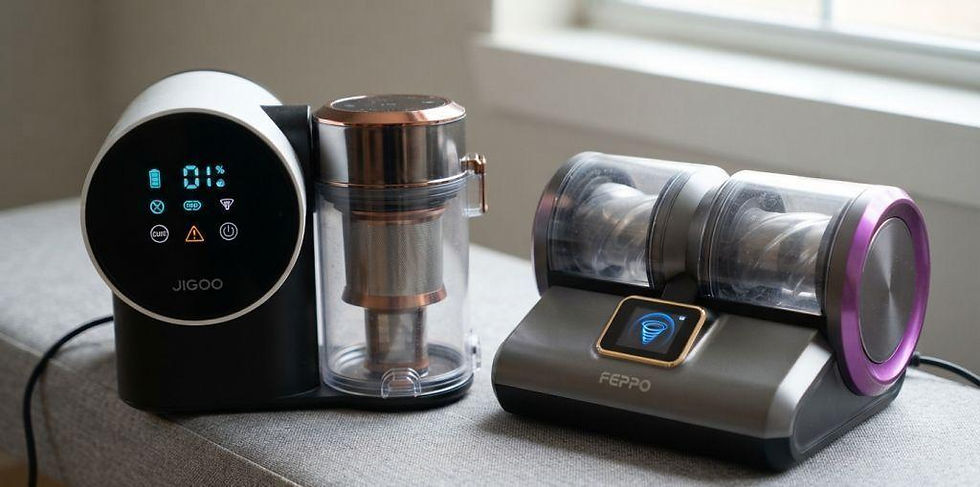
Critical Decision Guide: Real-Time Sensing vs. Maximum Raw Lift
Do UV mattress vacuums really kill dust mites and remove allergens?
Yes, but the UV light is only one part of the process. A germicidal UV-C bulb requires steady exposure to fully neutralize microscopic pests, and quick passes across a bed only offer surface treatment. The real power comes from the combination: high-frequency agitation shakes buried dust free from the foam, strong 13–16 kPa suction pulls the dander and mite waste into a sealed filter, and 130°F–140°F dry heat strips the fabric of internal moisture, creating an environment where mites cannot survive.
Choose the JIGOO J300 if you want visual feedback that an area is truly clean. The color-coded sensor ring keeps you from rushing your passes, and the dual-canister layout prevents suction loss when dealing with lots of fine powder.
Choose the FEPPO if you share your home with shedding pets or have thick, deeply tufted upholstery. The green beam reveals stubborn fur immediately, and the stronger 16 kPa suction pulls heavy debris out of dense fabrics effortlessly.
Practical Maintenance & Care Tips
These machines pull an surprising amount of fine, chalky powder out of a clean-looking bed on the first run. Keeping them running smoothly comes down to a few basic habits:
Clean Filters Thoroughly: Tap your pleated filter inside a wastebasket to remove loose dust before rinsing it under cold water. Never reinstall a filter while it is damp—trapped moisture mixed with skin dust creates a paste that clogs the motor. Let it air-dry completely for 24 hours.
Keep Stride Speed Slow: Moving the vacuum like a floor mower doesn't give the heating element enough time to warm the fabric. Glide slowly—taking about four to five seconds for each two-foot pass—so the heat penetrates and the agitator can vibrate deep dust upward.
Clear the Surrounding Air: Emptying fine allergen canisters can kick dust back into your bedroom. Running a reliable HEPA air purifier for dust and mold nearby keeps airborne particles from settling right back onto your fresh sheets.
Don't Overlook Pillows: While mattresses get the most attention, pillows trap just as much moisture and dander close to your face. Using washable zippered pillow protectors alongside periodic vacuum passes keeps your entire sleeping area fresh.
Final Verdict: Which One Should You Buy?
Buy the JIGOO J300 If:
You want an LED sensor ring that clearly indicates when an area is free of dust.
You prefer a dual-cup system that keeps fine powder separate from hair and lint.
You want the extra reach of a longer 16.4-foot power cable.
You are cleaning delicate quilted mattresses and prefer a gentle rubber-and-metal roller.
Buy the FEPPO If:
You want maximum raw suction power (16 kPa) for dense mattresses and couches.
You have shedding pets and need the green beam to highlight fur on light sheets.
You want warmer 140°F airflow to thoroughly dry out upholstery fabric.
You are looking for strong deep-cleaning specs at a budget-friendly price point.


Comments