Best Sanders for Kitchen Cabinets: Orbital vs. Detail Sander (2026 Guide)

You bought the Best Paint Sprayer for a flawless finish. You picked out the perfect Cabinet Hardware. But if you skip the most important step—sanding—your kitchen renovation will fail before the first coat of paint dries.
Sanding isn't just about smoothing out rough wood. It's about "scuffing" the old glossy finish so the new primer has something to grip onto. Without it, your expensive paint will peel off in sheets within a year.
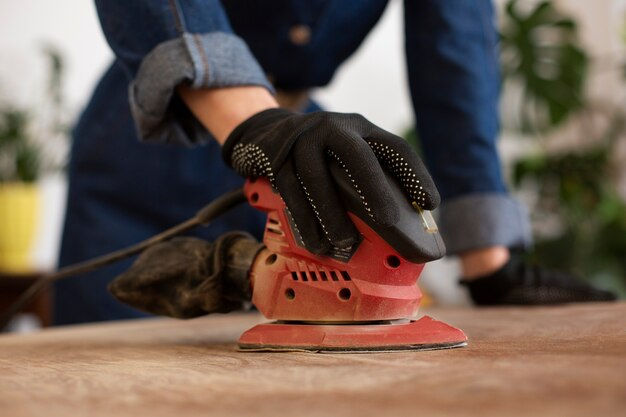
But sanding by hand is tedious and painful. You need a power sander. The question is: Do you need a round Random Orbital Sander for speed, or a pointy Detail Sander for corners?
We tested the best sanders for kitchen cabinets to help you prep like a pro without spending weeks in a cloud of dust.

Cheat Sheet: Orbital vs. Detail Sander
Which tool fits your project?
Feature | DeWalt 20V Max (Orbital) | Black+Decker MOUSE (Detail) | SKIL 5-Inch (Orbital) |
Shape | Round Disc | Triangular Point | Round Disc |
Best For... | Power / Speed (Doors/Drawers) | Corners & Tight Spots (Frames/Trim) | Budget / Flat Surfaces |
Speed | Fast / Aggressive | Slow / Precise | Medium / Steady |
Finish Quality | Swirl-Free (High Quality) | Good (Can leave scratches) | Good (Consistent) |
Price | $46 | $42 | $37 |
Why You Can't Just Use Your Hands
"Can't I just use a sanding block?"Technically, yes. But a standard kitchen has 20-30 doors and drawers, plus frames. That is thousands of square inches. Sanding by hand will take days and leave your arms aching.
A power sander does the work of 100 hand strokes in a single second. It ensures a consistent, even scratch pattern that manual sanding simply cannot replicate.
For extremely intricate carvings where even a detail sander won't fit, use a Rotary Tool with a Sanding Drum.
1. Best Overall (Power): DeWalt 20V Max Random Orbital
If you want to get the job done fast, the DeWalt 20V Max XR is the industry standard.
The Tech: 5-Inch Random Orbital (Cordless).
Why It Wins: "Random Orbital" means the pad spins and wiggles in random ellipses. This prevents the dreaded "swirl marks" you get with cheaper sanders. Being cordless means you can take the doors outside to keep the dust out of your kitchen.
Dust Collection: The attached dust bag actually works, capturing about 80% of the sawdust.
2. Best for Corners (Detail): Black+Decker MOUSE
Cabinet doors are square. Orbital sanders are round. You see the problem?
To get into the inside corners of Shaker-style panels, you need the Black+Decker MOUSE.
The Tech: Detail Sander (Corded).
Why It Wins: The triangular "iron" shape fits perfectly into 90-degree corners. It comes with a "finger" attachment that extends out for super tight spots.
The NestAlpha Take: It isn't powerful enough to strip a whole door quickly, but it is the perfect companion to an orbital sander for finishing touches.
3. Best Budget Pick: SKIL 5-Inch Orbital
If you are on a tight budget and don't mind a cord, the SKIL 5-Inch Random Orbital is a steal.
The Tech: Corded Orbital Sander.
Why It Wins: It has a powerful 2.8 Amp motor (stronger than many cordless models) and uses standard 5-inch hook-and-loop discs.
The Cons: You are tethered to an outlet, and the vibration is a bit stronger than the DeWalt, so your hand might tingle after an hour.
Sanding Grit Guide: Don't Ruin Your Doors
Buying the sander is step one. Buying the right sandpaper is step two.
80-100 Grit (Coarse): Only use this if you are stripping old, peeling paint down to raw wood. Warning: This can leave deep scratches.
120-150 Grit (Medium): The sweet spot. Use this to scuff up the old glossy finish ("de-glossing") without removing the underlying stain.
220 Grit (Fine): Use this between coats of primer and paint to knock down any bumps or dust nibs for a glass-smooth finish.
Once the dust settles, check your work with bright light. Our guide on Under Cabinet Lighting can help spot missed patches.
Final Verdict: Which One Should You Buy?
For a full kitchen renovation, the honest answer is: You probably need both.
The Workhorse: Buy the DeWalt Random Orbital to tackle 90% of the flat surfaces (doors and drawer fronts).
The Finisher: Buy the cheap Black+Decker MOUSE ($30) specifically for the corners and frames.
Trying to sand a square corner with a round pad is impossible. Spending an extra $30 on the detail sander will save you hours of frustration and hand-cramping.
FAQs
Q: Do I need to strip all the old paint off?
A: No! You only need to remove loose, peeling paint. For the rest, you just need to "scuff sand" (de-gloss) the surface so it looks dull. This gives the new primer microscopic grooves to stick to.
Q: Can I use a belt sander?
A: Absolutely not. Belt sanders are incredibly aggressive. They will eat through the veneer of your cabinet doors in seconds, ruining them forever. Stick to Orbital or Detail sanders.
Q: How do I clean the dust off before painting? A: After sanding, vacuum the doors with a brush attachment. Then, wipe them down with a Tack Cloth (a sticky cheesecloth) to pick up the microscopic dust that ruins paint finishes.


Comments